If you've ever wondered How to become an orthodontist in Spain, You probably already know that it's not a short path... but it is one of the most comprehensive in dentistry.
The orthodontics It not only addresses tooth alignment, but also directly influences chewing function, periodontal health, and, in many cases, the patient's quality of life, which explains the increasingly important role of the orthodontist in clinical practice.
In this article you will discover, step by step, What to study to become an orthodontist, What real options do you have in Spain and what skills make the difference when you are already working in the field?.
Basic requirements to become an orthodontist in Spain
The first step is clear: you need to take the course Degree in Dentistry.It is an essential requirement to be able to practice as a dentist and, subsequently, specialize in orthodontics.
This degree program lasts 5 years (300 ECTS credits) and is offered at public and private universities throughout Spain. During the program, students acquire knowledge in anatomy, physiology, oral pathology, surgery, prosthodontics, and, of course, a foundation in orthodontics.
Each one has its own cut-off scores, prices and teaching approach, but they all lead to the same point: obtaining the official degree that enables you to practice.
What if you are already a dentist in another country?
If you have studied outside of Spain, you will have to homologate Your degree. This process is managed by the Ministry of Universities and may involve:
- Validation of studies
- Possible additional training
- Language proficiency accreditation
You can consult the official procedure for the homologation of the degree here.Only after this step will you be able to to legally practice as a dentist in Spain and continue with your specialization.
Options for specializing in orthodontics in Spain
Once you've finished your degree, the big decision arrives: how to specialize. This is where many professionals get lost, because there isn't just one path. Let's order the options from least to most in-depth.
Orthodontics courses (basic level)
They are the fastest entry point. These courses usually have a short duration (from weekends to several months) and are designed to introduce you to basic concepts.
They do not award an official qualification, However, they do offer certificates specific to the training institution. These are useful if you want to begin understanding the specialty or complement your general practice, but they don't make you a specialist.
Private Master's degrees in orthodontics
Here the level rises considerably. private master's degrees they usually last between 1 and 3 years and are taught by specialized academies or institutions. Many include clinical practice, real case planning, and training in digital orthodontics.
Although most They do not have an official regulated qualification., They do provide a much more solid and practical training, geared towards real clinical practice.
Official university postgraduate programs
It is the most comprehensive and demanding option. university postgraduate courses in orthodontics They are usually accredited with ECTS credits and can last 3 years or more. Some include up to 180 ECTS credits and intensive clinical training.
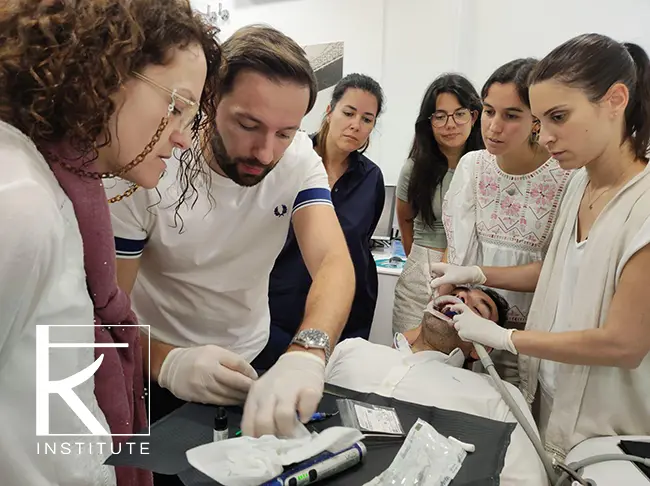
Furthermore, many of these programs follow an approach based on scientific evidence and on the supervised clinical practice, which makes them the closest option to a regulated specialization.
Do you want to delve deeper before choosing?
If you're considering pursuing a postgraduate degree, it's worth carefully analyzing all the variables before deciding. Not all master's programs are the same, and choosing the right one can significantly impact your professional development.
👉 We also recommend you read the article: How to choose the best orthodontics master's degree in Spain, where we analyze in detail what you should consider before making this decision.
Comparative table of training options
| Type of training | Approximate duration | Indicative price | Certification |
| courses | Days to months | €300 – €3,000 | Unofficial |
| Private Master's Degree | 1-3 years | €10,000 – €40,000 | Own |
| University postgraduate studies | 3 years (approx.) | €25,000 – €50,000 | Official ECTS |
Which option is better? Discover the main differences between specializing as an orthodontist in Spain through a university master's degree or private master's degree. Read now >
Key skills to be an orthodontist in Spain
Being an orthodontist is not just about studying or accumulating degrees, but about understanding that you work with people, not just teeth.
The technique It's essential, but not enough. You can master biomechanics, digital planning, or the most advanced protocols, but if you don't know accompany the patient During a long treatment, explaining what is happening and building trust is difficult; the result suffers.
Orthodontics requires a subtle blend: clinical accuracy and human sensitivity. It requires discipline to plan each case, consistency to follow through for months and adaptability in an environment that is constantly changing with new technologies and digital approaches.
But above all, it demands criterion. Knowing when to move forward, when to pause, how to communicate, and how to keep the patient engaged. Because ultimately, the best results depend not only on what you do in the clinic, but also on how you get the patient involved in the process.
If you're wondering How to become an orthodontist in Spain, The answer is clear: start with dentistry, continue with a solid training in orthodontics and develops skills that go far beyond technique.
The path isn't short, but it is very rewarding. And in a sector where technology and demand continue to grow, studying orthodontics in Spain remains one of the most promising career choices in healthcare.
Ultimately, it's not just about straightening teeth. It's about understanding function, aesthetics, and, above all, the person in front of you.
–
Become an orthodontist in Spain with a
Double Master's degree with official university qualification.
Learn more